For Debutantes, Marathon is a Mixed Bag
 by Peter Gambaccini
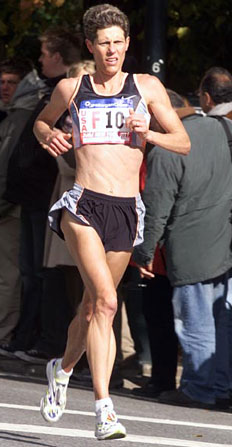
“I had a dream that I was going to
run 2:27:02,” Marla Runyan revealed,
not long after clocking a 2:27:10 in her
first marathon, in New York City on November
3. It was a spectacular debut, good for fifth
place overall and making Runyan the highest
American woman finisher in the New York City
Marathon since Kim Jones took fourth in 1996,
and moving her into fifth place on the all-time
U.S. women’s marathon list.
Runyan, 33, joined a sizable group of high-profile
athletes running their first 26.2-miler at
the 2002 New York City Marathon. As a legally
blind 2000 Olympian and reigning USATF outdoor
5000-meter champion, hers was the most widely
anticipated debut, and ended up being among
the most impressive. Yet as the stories here
reveal, all the first-timers had much to
learn from their first crack at the marathon
distance.
Much attention focused on how the visually
impaired Runyan would cope with a course
that’s far less predictable than an
oval track. A pair of cyclists was employed
to give Runyan verbal cues about miles splits,
the nature of the lead pack, the location
of fluid stations, and other information
readily available to better-sighted athletes,
and that arrangement “worked great,”
she said.
As she clicked off the miles, Runyan was
pleasantly surprised by how quickly the time
seemed to pass. “It didn’t feel
as long as I thought it would,” she
said. She felt equally sanguine about New
York’s separate early start for the
elite women. “Sometimes it becomes
annoying with men around you, because their
stride and their cadence is so different,”
she commented. The separate start eliminated
that problem, along with the need to distinguish
female from male runners. “On First
Avenue I started to count how many girls
were there. I think there were eight at that
point. Had the men been there, I wouldn’t
have been able to do that.”
Like all New York City Marathoners, Runyan
reveled in the crowd’s enthusiasm.
“I heard a lady at 22 [miles], she
said ‘I saw you on TV—you go
girl!’ It was awesome to have that
support,” beamed Runyan. Summing up
her maiden marathon voyage, she said, “I
don’t think it could have gone any
better.”
As extraordinary as Runyan’s debut
was, she was not the fastest first-time woman
in New York in 2002. That distinction went
to Olivera Jevtic of Yugoslavia, who had
finished fourth in the New York Mini 10K
in in June, then declared she wished to make
her marathon debut in New York. She did so
on November 3, placing third in a national-record
2:26:44.
Jevtic, 25, looked formidable as the the
contenders crossed the Madison Avenue Bridge
from the Bronx back into Manhattan near 21
miles, when Australia’s Kerryn McCann
collided with her from behind, sending both
women crashing to the pavement. Despite bruises
and cuts on her elbows and knees, Jevtic
quickly rejoined the chase. “I never
thought I wouldn’t be able to finish
the race,” she said later, “but
[the collision] was at a crucial moment.
It was when I needed to pick up speed.”
Jevtic could not regain contact with eventual
winner Joyce Chepchumba and runner-up Lyubov
Denisova, but afterward, she seemed radiantly
happy to take the third spot on the awards
podium.
It had been 20 years since an American man,
Alberto Salazar, won the New York City Marathon
and it had been almost that long since an
American had challenged for the lead on First
Avenue in Manhattan. But on Sunday, there
was U.S. 10,000-meter record holder Meb Keflezighi,
pulling alongside leader (and eventual winner)
Rodgers Rop. “Rop made a move, I just
followed him,” Keflezighi stated.
There was great anticipation about Keflezighi’s
first marathon, particularly after one of
his American rivals, Alan Culpepper, debuted
with a 2:09:41 in Chicago. In New York, Keflezighi
could not hold on to Rop’s pace and
finished ninth in 2:12:35 after hitting the
Wall at 22 miles.
“I don’t regret it at all,”
said Keflezighi, 27, of his bold strategy.
“I live and learn.”
As for trying another marathon, Keflezighi
was in no rush. “I like the 10K better,”
he admitted. “But obviously, my first
10K didn’t go well either. I got lapped.”
Mark Carroll, who passed Keflezighi in Central
Park, is the Irish record holder at 3,000,
5,000, and 10,000 meters. He was thought
to have an outside shot at breaking John
Treacy’s national marathon mark of
2:09:18 in his first attempt at the distance.
But Carroll, 30, was aglow after taking sixth
in 2:10:54 in New York. “I loved it,”
he said. “The crowd propelled us right
through Brooklyn and the other stages. It
was just a great atmosphere.”
In the early going, Carroll was in the lead
men’s pack, but often ran alone, off
to the side. “There are probably a
few reasons for that,” he smiled afterward.
“The Kenyans are great runners, but
they don’t like to run in a straight
line. I’m always conscious of one of
those guys stepping in front of me and taking
me out. I had a couple of close calls today.”
When the leaders surged on First Avenue,
Carroll wisely held back. “I was 10
miles from home and I decided ‘this
is a long way to go to be running that quickly,’”
he said. “You’ve got to maintain
your form and your composure.” Carroll
did just that, moving up several places over
the tough final 4 to 5 miles.
Besides Runyan, the other prominent American
female debuting at 26.2 miles was Kim Fitchen-Young,
34, a fourth place 10,000-meter finisher
in the last two USATF Championships. The
Californian hung on to the back of the lead
pack for the first 4 miles, but drifted back
to 14th place in 2:38:05—still an A-standard
qualifying time for the 2004 U.S. Olympic
Marathon Trials.
Fitchen was one place in front of Carol Howe,
originally from Winnipeg, Manitoba but now
residing in Summit, New Jersey. Howe called
the marathon “something I have always
wanted to do” and figured, “at
36, I’m not getting any younger.”
She won Grete’s Great Gallop Half-Marathon
in Central Park in 1:14:58 on October 6 as
a tune-up for her 26.2-mile debut.
Though not happy with her 2:38:37 finishing
time, Howe’s disappointment did not
dampen her praise for the marathon and the
women’s separate start, which highlighted
the elite females as never before. “The
field today was incredible, and I think what
this did for female distance running is also
incredible,” she said. Still, the set-up
challenged Howe. “I ran the entire
thing by myself.” Indeed, 100 meters
into the race, the leaders had already pulled
away. “If I went up with those ladies,
that would have been suicide for me. But
on the flip side, [running alone] was very
draining.”
Howe’s Canadian compatriot Jeff Schlieber,
29, was 11th in 2:14:13 in his marathon debut.
Kenya's Laban Kipkemboi, age 24, ran an outstanding
2:08:39 debut, good for third place. Also
faring well was Matt O’Dowd, 26, of
Great Britain, who rallied strongly to take
eighth in 2:12:20. O’Dowd, 26, who
had a half-marathon best of 1:02:38, is a
graduate of Loughborough University, the
alma mater of another 2002 marathon debutante,
women’s world record holder Paula Radcliffe.